Posts

Hydrophobic Soils

Image
At recent green committee meetings I have harped on about the lack of winter rainfall and the potential consequences we could experience as a result. In the main, I have focused on the added pressure, with a 4 week earlier start to irrigation than average, on our water allocation particularly towards the back end of the season. Combined with the earlier start we are also contending with the need to increase usage above that normally used as the dry weather continues through Spring. We are limiting usage where we can, carefully monitoring consumption and will balance the levels over the course of the irrigation season. The other consequence of this drier than average weather pattern, is the development of Hydrophobic soil conditions or water repellent soils, in basic terms a situation where a soil will not wet regardless of the amount of water applied. Generally we experience this problem at some point through the summer season, on all turf areas to varying degrees, West Australia...
3rd surrounds

Image
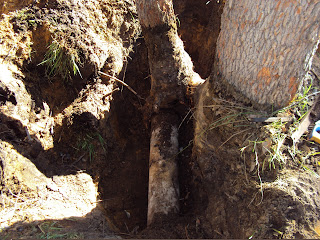
Works to the 3rd green surrounds was completed this week despite loosing some time to repairing a main line break on the back 9 caused by tree roots. The offending tree roots and tree were removed.  Getting back to the 3rd, all work was carried out by staff, the turf was cut from the surrounds and set aside for laying later, sand from the 4th pit used to create the mounding and extra turf cut from the practice fairway to cover the area. The green will now have a 1m collar before sloping off rectifying the problem of balls being putt of the green with the sharp and sudden drop that was. The area will be G.U.R till establishment. In other news, the greens were given their first cut after Reno's last Monday at 6mm and have been cut everyday since, we will gradually lower the height over the next week and should be 4mm next weekend, 3mm the week after. The tees are recovering well from the renovations to them and both greens and tees should be in great condition ...

What A Month

Hello Everyone, Today capped off a huge past 4 weeks for staff with completion of the tee and surrounds renovations with the top dressing of these areas. Prior to this we had the successful preparations for the Capel 3000 and the extra attention to detail given to the course for a major event with the course presented in great fashion. We then had a week where only Anthony and myself were on duty, before the greens renovation this past weekend and followed up this week with the coring of all the tees, bunker surrounds, walkways and the Practice tee and top lawn area. On top of this, the unusually dry warm weather through Winter has continued through September meaning an earlier than expected start to irrigation of the course. With the manual system on the back 9 still in operation, time had to be devoted to this critical part of course operations which wasn't expected when finalising the works program 6 months ago. During this month we have farwelled Geoff, who yo...

Greens Renovation Pictorial

Image
The greens renovations were completed this past weekend, some pics follow. Using Solid Tines Holes Opened  Applying Amendments  Top Dressing   Brooming Sand  After Brooming All up the greens renos took 10hrs to complete, the greens also had excess sand removed by hand boarding, and brooming. -------------------------------------------------------------------------- This week we have cored all Tees, Walk ways and most Surrounds using our small corer. Verti cutting of the worst "thatched up tees" is progressing. Fertilising, amendments and Top dressing will be completed By Friday.

Greens Renovation Info

With our biennial greens renovation fast approaching I thought I would answer some common questions we receive by players at this time of year. Why Renovate? Without getting technical, there are a number of reasons why we renovate the greens, to relieve compaction, to get air into the profile, reduce any thatch build up and to add soil amendments when the greens are open from coring. To be blunt if we didn’t, the greens would deteriorate in condition and eventually die. Further explanations follow. Why Core ? Like so many things, the quality of a good putting green is more than skin deep. In fact, the condition of a green has a lot to do with what goes on below the surface. In order to keep grass growing at 3mm you have to have deep, healthy roots. Good roots demand oxygen. In good soil, they get the oxygen from tiny pockets of air trapped between soil and sand particles. Over time, the traffic from golfers' feet (as well as heavy mowing equipment) tends to compac...

Trial Fertiliser

We will be trialling a new liquid fertiliser product for fairways this season. By using liquid rather than soluble fertilisers as we have done in the past to supplement the granular fertiliser applications, we will be able to reduce the time taken for refill as we won’t have to dissolve the fertiliser at mixing. This can take anywhere between 30 minutes to 45 minutes depending on the product used before heading out to continue applying the fertiliser. With only a 600L boom we generally have to refill 6 times to complete the Fairway areas only. This then means we have to spread the application out over 3 mornings as we don’t want to be spraying in the heat of the day or disrupt play. Unlike the soluble products where we need to mix with water and spray the mixture at 300L per hectare due to having to dilute the product, the liquid alternative only requires a maximum 20 to 30L of water per hectare. Therefore, not only do we save time with not having to dissolve the fertiliser at...

RETIC

Image
The last of the sprinklers for additional coverage of green surrounds on the front 9 were installed this week in time for the coming Irrigation season. The areas highlighted last season as requiring extra coverage will not have the problem of drying out as they did and will allow us to further improve the irrigation of greens with more precise amounts applied, rather than having to irrigate the greens for extra time just so the surrounds could get some more water. All the installation was undertaken by course staff, including the Valve in Head sprinklers which required wiring into the system.  The same Toro DT series sprinklers were used with smaller nozzles as the rest of the front 9 with varying circle arcs from 180 to 270 degrees to cover surrounds. Using the same model sprinklers uniformly across the course means less parts need to be on hand.  The installation required cutting into the green line pipe, fittings glued for the Sprin...