Posts

Showing posts with the label turf care 101

Saltene and Couch Grass

Image
I thought I would talk about this subject instead of what has been run of the mill course work updates lately, nothing like a bit of variety to keep it fresh... It is this time of year (summer if you didn't know better) the couch and saltene in the greens become more visible and start to out compete the bent grass. If you have been good students and followed the turf 101's on this blog you would know Bent is a cool season grass preferring cooler temps, Couch and Saltene both warm season grasses preferring hotter temps for optimum growth. So what happens when the two compete against each other year round ?   During the cooler months,  April through October the Bent grass out competes the Couch and Saltene, the Couch and Saltene are still there just not as pronounced as during the warmer months, thanks to their vigorous rhizomes even tho the bent has control of the top, the couch and saltene are waiting to pounce when warmer temps arrive due to their extensi...
The Not So Obvious

We all know the obvious impacts for the course from the storm, (I am totally over that word) but there are a few not so obvious impacts which I informed the course committee of and thought the general membership should also be aware. Green Speed - The greens may run a little slower in the short term, we could not cut greens for nearly a week, we were forced to raise heights slightly, this does impact on green speeds. We have since lowered the heights but more of an impact comes from the reduced frequency of cut and will take some time to gain the condition back from regular mowing, (we are still not at pre storm frequency). In short the more often we cut, the finer the leaf, the quicker the greens, it's a little bit more complicated than that, but that is the general idea. Disease Issues - With wet weather, a mixed bag of weather conditions and lost time for some cultural practices usually completed, some disease issues are expected in greens, tees and fairways. We managed...

GREENS AND THE HEAT

 On course temperatures between 38 degrees and 41 degrees have been recorded over the last few days and the predictions are it is set to continue over the next week, please read and encourage your fellow members to take note of a few important points at this time. If your playing over the next week or so while temperatures are nudging towards 40 degrees, (first I would say you are certainly dedicated to your game), seriously tho you may notice a few precautions being taken with the greens during the heat we don't usually do at other times, to protect against loss of turf through heat stress. Some measures that may impact your round that you may come across that you don't normally and the reasons for them are below - Syringing greens during the day, between 1.30pm and 4pm - ( a very light handwater to cool the greens down during the hottest part of the day) Reason - If the bent grass gets to hot under these conditions the plant can basically shut down restricting the normal...

Insight into Bunker Maintenance

Image
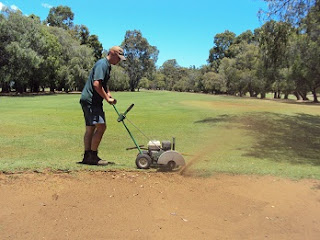
Ask most players on any golf course about Sand Bunker Maintenance and the answers will come thick and fast. Not enough maintenance carried out, The appearance needs looking after, Not enough Sand, Too much Sand, Bases aren't level, to much rubbish in them. And the list would go on, ask them what maintenance do they think gets carried out and the most likely answer is they rake them with a bunker rake and maybe do the edges every now and then but never enough. With this in mind here is an insight into one aspect of Bunker maintenance, the dreaded bunker edges as the staff refer to it with a groan. Every 4 weeks during the growing season and every 6 to 8 weeks at other times, all bunkers are edged, Trimmed, cleaned out and raked, a pretty simple sounding maintenance task unless you are aware of whats involved. It can take 4 staff up to 10 working hrs to complete, THAT'S 40 WORKING HOURS EVERY MONTH !  First up is to edge the bunker, getting a sharp clean cut edg...

Greens Reno

We had a great turn out of volunteers for the weekend Reno's. A huge Thank you to all from the Greens staff, without your help we would be still going. Renovations went very smoothly, there was no lifting and plenty of cores removed and nearly just as much sand added to fill those cores all golfers love so much. Unfortunately I am still unable to upload pics so a brief description of what we did follows - Verti - Cut Greens -- This was to achieve 3 outcomes, 1) Remove some excess thatch, 2) To "crack open" the Couch and Saltene encroachment into the greens to allow for better chemical control and 3) create a seed bed for over sowing patches. Hollow Cored -- We were very aggressive with coring using 5/8 inch tines to a depth of 6 inches, this is part of the alternating cycle of using hallow and solid coring techniques where the solids used during spring are smaller and not as deep. Our objective is simple in Autumn renovations, relieve compaction, improve air and wate...

Front 9 Fwy Renovations

Image
With the fairway in great shape, I keep asking myself why oh why are you still planning on ripping them up and then having a long recovery period before they are back in the same condition ? The answer is the same, if it isn't done, I know through the remainder of summer it will be next to impossible to keep the fairways in the condition they are in now. Why is it that you ask ? The thatch layer I have referred to when talking of the greens renovations is the main culprit and target for the Fairway renovations. Wintergreen Couch is a phenomenal grower and thatches up naturally very quickly, under high maintenance regimes this is more so. Generally at around 15mm to even 20mm is acceptable, any higher and if nothing is done, trouble is just around the corner. Thatch as I have said before is the layer of dead and growing matter between the green leaf and soil, at 15mm or below in depth it is beneficial as it helps out compete weeds and helps retain soil moisture through warme...

Hydrophobic Soils

Image
At recent green committee meetings I have harped on about the lack of winter rainfall and the potential consequences we could experience as a result. In the main, I have focused on the added pressure, with a 4 week earlier start to irrigation than average, on our water allocation particularly towards the back end of the season. Combined with the earlier start we are also contending with the need to increase usage above that normally used as the dry weather continues through Spring. We are limiting usage where we can, carefully monitoring consumption and will balance the levels over the course of the irrigation season. The other consequence of this drier than average weather pattern, is the development of Hydrophobic soil conditions or water repellent soils, in basic terms a situation where a soil will not wet regardless of the amount of water applied. Generally we experience this problem at some point through the summer season, on all turf areas to varying degrees, West Australia...

Greens Renovation Info

With our biennial greens renovation fast approaching I thought I would answer some common questions we receive by players at this time of year. Why Renovate? Without getting technical, there are a number of reasons why we renovate the greens, to relieve compaction, to get air into the profile, reduce any thatch build up and to add soil amendments when the greens are open from coring. To be blunt if we didn’t, the greens would deteriorate in condition and eventually die. Further explanations follow. Why Core ? Like so many things, the quality of a good putting green is more than skin deep. In fact, the condition of a green has a lot to do with what goes on below the surface. In order to keep grass growing at 3mm you have to have deep, healthy roots. Good roots demand oxygen. In good soil, they get the oxygen from tiny pockets of air trapped between soil and sand particles. Over time, the traffic from golfers' feet (as well as heavy mowing equipment) tends to compac...